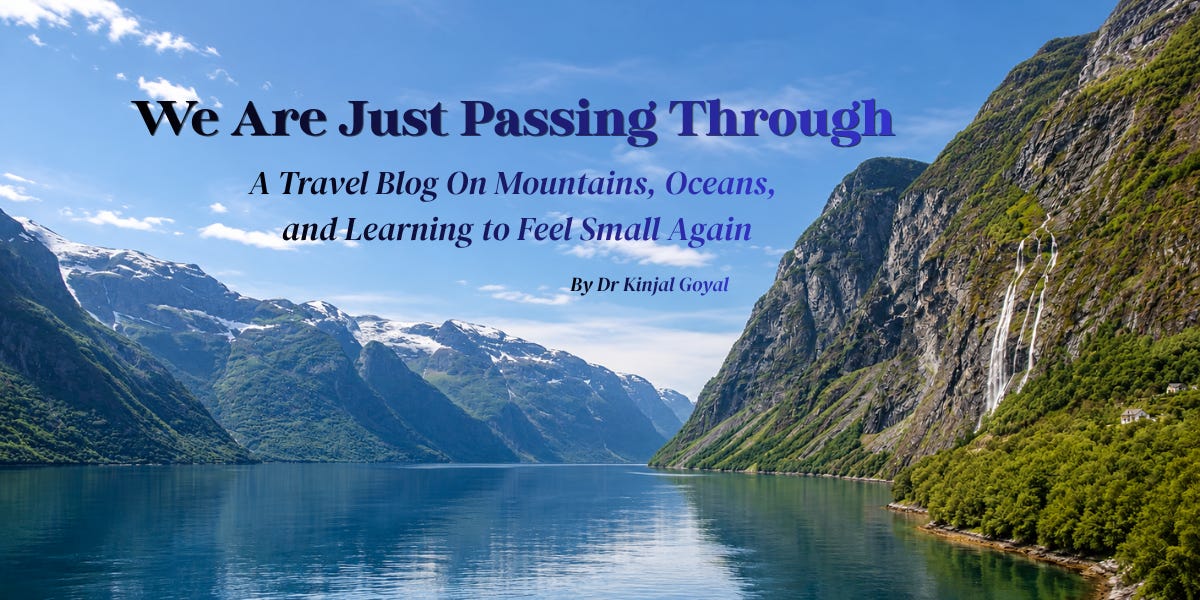
We Are Just Passing Through
A Travel Blog on Mountains, Oceans, and Learning to Feel Small Again by Dr Kinjal Goyal

Whenever I travel towards the sea and stay by a large body of water, I experience something that is difficult to explain in purely geographical terms. It feels like coming home. There is an immediate sense of recognition, almost as though I have reached a state of homeostasis with the environment around me. What exists inside me, the temperature, the humidity, the constant presence of water, finds its equivalent outside me. There is only a thin barrier of skin separating the two, and everything else feels remarkably synchronized.
Ironically, water makes me feel grounded. It makes me feel as though I have entered a state of flow. I have always considered myself a water person. I enjoy being in the water, being by the water, and inhabiting climates that do not demand too much negotiation from the body.
This summer, however, I spent time among the fjords of Norway, and I encountered something entirely different.
The rawness of the mountains and the simple fact that they refuse to be predicted stirred something in me that I had perhaps never experienced in cities, crowded spaces, or even by the ocean. We often say that mountains have stood the test of time, but standing before them gave that phrase an entirely different meaning. They stood tall long before us, and they will continue to stand long after we have passed into another realm.
What struck me most was not merely their beauty. It was their brutality.
Mountains do not make you feel welcome. They do not concern themselves with your comfort. They simply stand there. Vigilant, indifferent and entirely themselves.
And strangely, that indifference carries something personal and emotional.
You become aware of how utterly small you are. How inconsequential. How tiny and irrelevant your individual existence is in the vastness surrounding you. Yet rather than diminishing you, that realization seems to place you exactly where you belong.
On a sunny day, the fjords reveal themselves in all their magnificence. A few hours later, rain and wind can send you searching for shelter with surprising urgency. In places like these, you do not dress to impress. You dress to survive what nature has decided to offer that day.
There is something strangely liberating about that practicality. It peels away many of the unnecessary concerns we carry about ourselves. The endless focus on appearance, presentation, and image becomes less important when you are negotiating rain, cold, steep paths, and changing skies. You stop performing for other people and start responding to the environment.
Calling such landscapes breathtaking somehow feels incomplete.
Because they are also breath-giving.
The purity of the air, the endlessness of the water, and the sheer height of the mountains come together to create something that felt profoundly right. Everything seems to occupy the place where it belongs. The earth is exactly where it should be.
We are the ones passing through.
And I suspect that realization has changed something in me now that I am back.
As we spend enough years inside civilization, we gradually begin to believe that we are the dominant species and that the world should optimize itself for our convenience, our efficiency, and our comfort. We begin to assume that every inconvenience is a problem to be solved and every rough edge must be smoothed.
Standing in Norway challenged that belief.
The world does not really care.
The earth is resilient. It is older than us, bigger than us, and likely to outlast all of us put together. There is something deeply humbling in recognizing that reality. We do not own this planet. We simply tread through it for a brief period, and perhaps our responsibility is not to conquer it but to respect it and experience it in its actual form.
I sometimes wonder whether our obsession with optimization has gone too far.
Recently, I came across a health influencer who argued that travel is traumatic for the body and that changing time zones, food, temperatures, and sleep schedules accelerate ageing. From a physiological perspective, there is truth to some of these observations. Long flights, circadian disruptions, and unfamiliar environments certainly place demands on the body.
But I am not convinced that anything stretches the mind quite like travel.
We become deeply attached to our own pace, our own routines, and our own systems. Familiarity can slowly make us rigid. Unless we leave home every now and then and allow ourselves to surrender to the rhythm of another place, we risk mistaking our way of living for the only way of living.
In places far away from our own, everything moves differently. The timings are different. The food is different. People speak differently, think differently, and relate to one another differently. You realize very quickly that if you insist on doing everything your way, you will struggle. Survival, even in its most comfortable form, requires adaptation.
And perhaps that is one of the greatest gifts travel offers.
Flexibility and the willingness to bend.
The ability to inhabit another rhythm without demanding that it resemble your own.
As a psychologist, I think adaptability is one of the healthiest qualities a human being can possess. Travel exercises that quality in ways that books, videos, and second-hand stories never can.
I recognize that being able to see places so far away is a privilege. I do not take that privilege lightly.
I also believe that every traveller carries a responsibility. When we are fortunate enough to witness something as magnificent as the Norwegian fjords, we inherit a small obligation to protect what we have experienced. To leave it as natural as we found it and to resist turning every landscape into a commodity. To remember that future generations deserve the same sense of wonder.
After all, these mountains do not need us.
In fact, we need them far more than we realize.