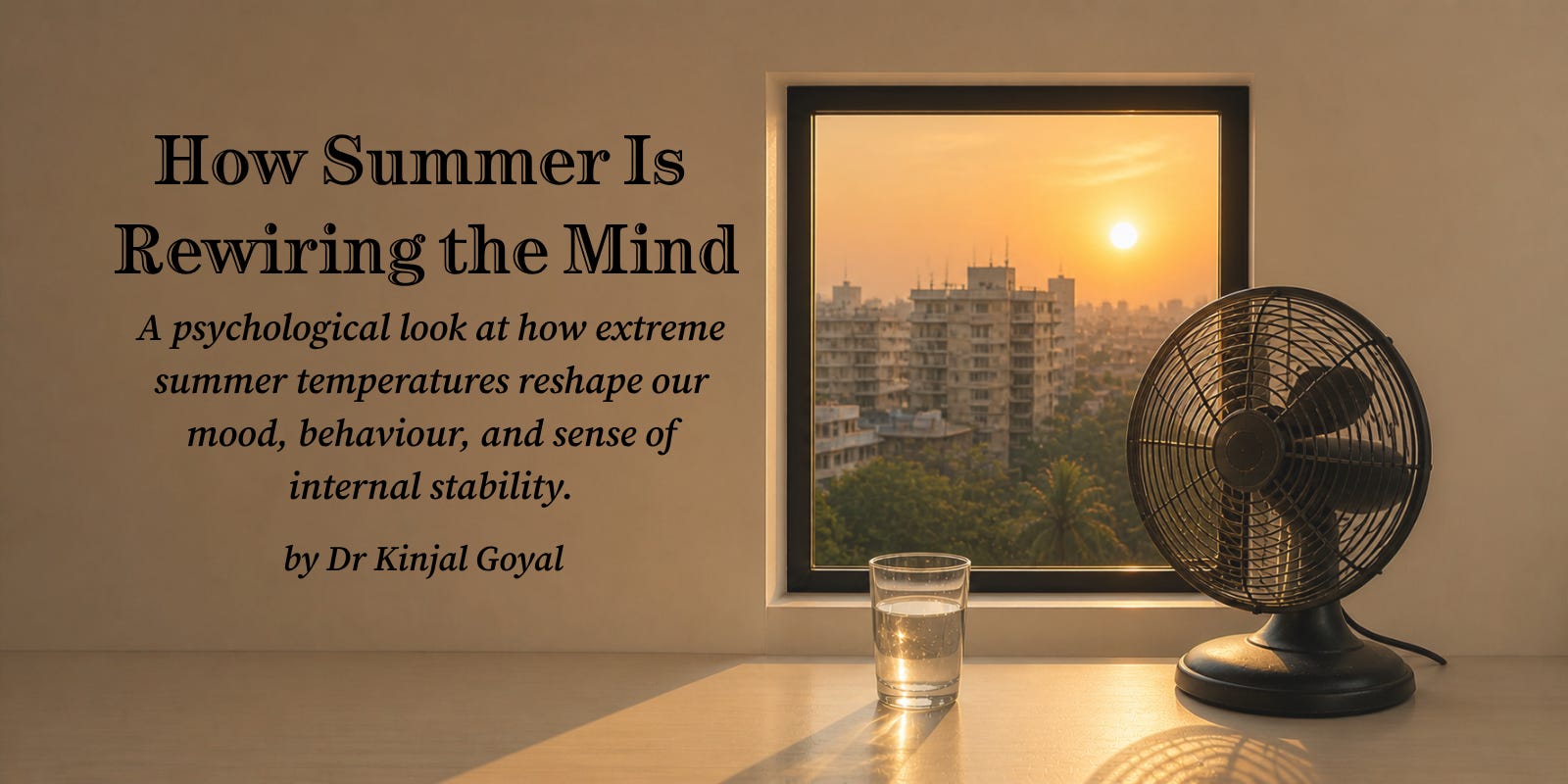
How Summer Is Rewiring the Mind
A psychological look at how extreme summer temperatures reshape our mood, behaviour, and sense of internal stability - By Dr Kinjal Goyal

Pune, like many Indian cities is running a fever. Not just metaphorically, but almost physiologically. At 42 to 43 degrees Celsius, the air feels thick, like something you need to push through rather than simply breathe. You step out for a few minutes and return altered. You cannot quite name this change, but it is enough to feel that something inside you has shifted.
Over the past few weeks, I have been noticing this in my consulting room as well. People are more irritable, more depleted, and far less patient with themselves and with others. There is a kind of cognitive fatigue that seems to be setting in collectively. Emotional thresholds have dropped and things that would usually feel manageable are beginning to feel like too much.
This is not anecdotal. A growing body of research now shows that extreme heat is not just physically taxing, but psychologically destabilising. As temperatures rise, so do hospital visits and admissions for mental health concerns, alongside a visible shift in everyday functioning, marked by irritability, low mood, and cognitive fatigue.
The mind does not operate independently of the climate it inhabits. It is deeply porous. It absorbs, registers, and responds to shifts in the environment around it. When the external world becomes hostile, the psyche does not remain a passive observer. It begins to take it in.
Heat, especially the kind we are experiencing right now, is highly uncomfortable and dysregulating. The body is constantly trying to restore equilibrium through thermoregulation, and that becomes a full-time internal task. There is sweating, dehydration, and a persistent sense of heaviness that is difficult to shake off. Sleep becomes fragmented because the body cannot cool down enough to enter deeper restorative cycles. And once sleep is affected, everything else begins to erode. Emotional resilience drops, attention becomes scattered and patience wears thin.
We often think of comfort as a luxury, when in reality, it is a psychological requirement.
When the environment feels unhinged, the mind expends enormous energy trying to re-establish stability. You adjust the fan, lower the blinds, take extra showers, look for shade, reach for water and seek relief in any form available. But alongside these physical adjustments, there is a deeper psychological effort constantly underway. You are trying to feel okay again.
And that effort is exhausting.
This is perhaps why people feel more on edge during extreme summers. There is very little buffer, very little space between stimulus and reaction. Minor inconveniences begin to feel disproportionately frustrating because the system is already strained. The mind and body are functioning under continuous, low-grade stress.
There is also the paradox of relief. Air conditioners hum across the city, offering immediate comfort. And yet, most of us have an awareness that this comfort comes at a cost. We know that excessive energy consumption contributes to the very climate patterns that are making summers harsher. There is a moral tension in seeking relief from something we are, in part, perpetuating.
But when temperatures reach this level, choice becomes limited. Survival instincts take precedence over abstract ethical concerns. We switch on the air conditioner simply because the body and mind are demanding reprieve.
Another theme that emerges during such weather is a distortion in the perception of time. Many people describe the days as feeling too long. There is an impatience with the afternoon, a dragging quality to the hours between noon and evening. Heat stretches time and slows movement, both physically and mentally. Tasks take longer, motivation dips, and procrastination increases, not always out of avoidance, but because the body simply does not have the energy to engage.
At night, when some relief is expected, sleep becomes its own struggle. Even with cooling, the body remains slightly unsettled. There is more tossing, more waking, and less depth to sleep. Over time, this accumulates into a chronic state of partial rest. And a partially rested mind is rarely a happy and productive one.
It is important to understand that these responses are not signs of weakness. They are adaptive reactions to an environment that is pushing the limits of what is comfortable and sustainable.
This brings me to a broader and often overlooked dimension of this conversation. Climate does not only affect those who stay. It profoundly shapes the lives of those who move.
We often speak about climate refugees in terms of displacement, loss of home, and economic instability. But there is another layer that receives far less attention - the psychological impact of moving across climates.
Imagine leaving a place that is not only culturally familiar, but also climatically attuned to your body. Your rhythms, habits, and even parts of your identity are shaped by the weather you have known. Now imagine entering a completely different climate, hotter, colder, drier, or more humid, but fundamentally unfamiliar.
The body has to learn again. And as the body recalibrates, the mind must adjust to an entirely new sensory reality.
This is not a small shift.
Climate is deeply embedded in identity. We know how certain months are supposed to feel, how festivals align with seasons, how the air changes at different times of the year. These patterns anchor us. For a climate refugee, this adjustment is layered on top of everything else, loss of home, loss of community, cultural dislocation, and uncertainty about the future. Alongside all of this, there is a body and mind that do not feel at ease in their new surroundings.
There is also the loss of sensory memory. Every place carries its own emotional calendar. Certain smells, sounds, and textures mark time. When climate changes drastically, that continuity is disrupted and time itself begins to feel unfamiliar.
In many ways, what we are experiencing in cities like Pune right now is a milder version of this dislocation. The climate we were accustomed to is shifting. Summers are becoming more intense, more prolonged, and less predictable. What once felt stable now feels erratic.
And the mind is noticing.
This may show up as irritability, fatigue, restlessness, or a vague but persistent unease. These are not isolated symptoms. They are part of a broader psychological response to a changing environment.
Perhaps the first step is acknowledgment. Recognising that our mental states are not occurring in isolation, but are in constant dialogue with the world around us.
The next step is to build intentional pockets of regulation. And I don’t mean in grand or unrealistic ways, but through small, consistent acts. Creating cooler spaces, keeping curtains drawn, adjusting routines to align with the weather rather than resist it and allowing for slower days without attaching guilt to them. Paying attention to hydration, rest, and the body’s signals is important too. Identifying the hours when you feel most functional and using them wisely can help get more work done with lesser guilt.
And perhaps, the most important, is cultivating compassion. For ourselves, and for others.
Because if the heat is getting to you, it is getting to everyone else too.
We often think we are reacting to our lives.
But sometimes, we are simply reacting to the temperature.
And we are only just beginning to understand what that means because we have not yet found the language for that shift.